

Electricity costs and demand spikes can affect businesses quickly as they grow. According to PV Magazine, Australia added 1.1 GW of new rooftop solar capacity nationwide, bringing the total capacity to 26.8 GW across 4.2 million properties. This demonstrates how solar power is becoming the preferred solution for businesses seeking energy stability and cost savings.
With that in mind, a reliable commercial solar installer can design a system that scales with your operations, lowers electricity costs, and provides long-term energy security. That said, we’ll explore how your business can design a scalable solar solution.
Steps to Designing a Scalable Solar Power System
Designing a scalable solar power system starts with understanding your current energy needs and projecting future growth. The following steps outline how to plan capacity, infrastructure, and storage to ensure your solar system can expand smoothly as your business grows:
Consider Capacity for Current Needs and Future Growth
Begin by reviewing your electricity bills from the past year to understand your consumption patterns and identify peak periods. Estimate how your energy needs will increase as your business expands, such as adding new offices, warehouses, or production lines. This information allows commercial solar installers to design a system that supports your current operations and future expansion without costly retrofits.
For example, a medium-sized warehouse might currently require a 100 kW system but plans to upgrade to 200 kW as operations increase. Planning in advance reduces the cost and complexity of later upgrades.
Plan Modular Capacity and Infrastructure
A modular system allows for the addition of extra panels, inverters, and batteries over time. Designing mounts, conduits, and inverter capacity with expansion in mind ensures that future upgrades can be completed efficiently.
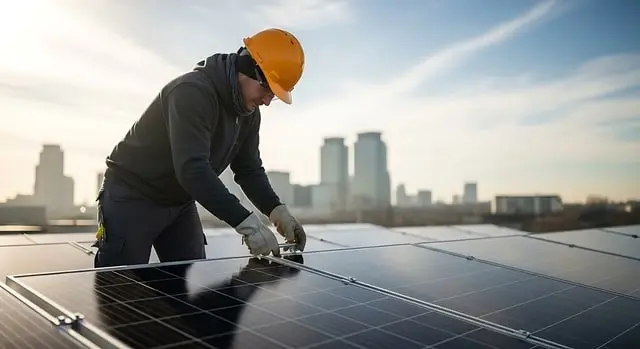
For instance, a retail business could install panels on part of a warehouse roof while leaving another section reinforced for future expansion. This makes commercial solar panel installation easier and reduces the risk of disrupting existing operations. Documenting wiring paths, inverter specifications, and structural limits also ensures that a future commercial solar installer can scale the system without having to start from scratch.
Include Battery-Ready Infrastructure
Integrating storage improves energy reliability and allows your business to manage electricity costs more effectively. According to PV Magazine, 43,517 solar batteries were installed alongside rooftop solar systems in early 2025, showing growing interest in combining solar and battery solutions.
Preparing your system for battery integration means that adding storage later will only require installing the batteries themselves. For businesses that operate extended hours, stored energy ensures solar power produced during the day can be used at night, reducing grid dependency. More Perth companies that offer solar and battery solutions increasingly rely on this approach to minimise electricity costs and ensure continuous operations.
Optimise Layout and Site Selection
Your commercial solar installer should evaluate your site carefully. For rooftops, check roof orientation, structural load, and shading, and consider how maintenance will be conducted. For ground-mounted arrays, make sure the area is clear and accessible.
Planning the placement of panels, inverters, and conduit ensures that future expansion is straightforward. A logistics company, for example, can start by covering half of its warehouse roof with panels, while leaving the other half reinforced for additional panels. This reduces the time and cost for future commercial solar installers during system expansion.
Install Monitoring and Energy Management Systems
Installing monitoring systems early allows you to track performance, detect inefficiencies, and plan expansions intelligently. For instance, if solar generation exceeds current demand during midday, the system can inform decisions about installing batteries or additional panels. With continuous monitoring, it ensures each expansion stage improves overall efficiency and reduces unnecessary energy waste.
Plan for Maintenance and Repairs
Even well-designed systems need ongoing maintenance. Partnering with a local electrician near you or a qualified service provider ensures the system remains functional and efficient. Routine inspections and solar panel repairs prevent small issues from affecting performance and help maintain a strong return on investment (ROI).
Businesses with multiple sites can also manage energy use consistently by scheduling inspections and monitoring production data from all locations.
Addressing Common Challenges
Many businesses are concerned about upfront costs when designing solar systems that can expand with future growth. While building for scalability can cost more initially, that cost often pays off. According to Energy Action, commercial solar systems commonly pay back in 3–6 years, and lifetime savings can exceed $500,000 over 20 years for mid-size systems.
With a professional commercial solar installer, they can assess your site and recommend solutions like reinforced rooftop mounts or ground-mounted systems to maximise capacity without compromising safety. Navigating compliance with local regulations can also be complex, but an experienced installer manages permits, grid connection requirements, and adherence to safety standards. This ensures your solar system operates efficiently and reliably as your business grows.
Start Scalable Solar Today!
Designing a solar system that grows with your business begins with understanding your current energy use and anticipating future demands. Planning flexible layouts, preparing for battery integration, and installing monitoring systems ensures your solar setup remains efficient as your operations expand.
That said, working with an experienced commercial solar installer simplifies the process. At SolArk Electrical, we help businesses design scalable solar solutions that align with growth plans, handle solar panel installation, and provide ongoing support. For more information, get in touch with us today!

Frequently Asked Questions (FAQs)
To learn more about designing scalable solar solutions, here are insights to keep in mind.
How long does it take to install commercial solar panels?
The installation time for commercial solar panels varies depending on the system size and site complexity. Most projects can be completed within a few days to a couple of weeks.
How do I find professional maintenance and repairs?
Search for a local electrician to get support for routine inspections and solar panel repairs, so your system operates efficiently as it grows.