
Electrical safety
How to tell if your Mandurah switchboard is overloaded or unsafe
Five signs, and what a board upgrade actually involves once you decide to do something about it.
The switchboard is the one piece of electrical equipment in the house that everything else depends on, and it is the one nobody thinks about until it does something alarming.
It is also carrying a load nobody designed it for. A house built thirty years ago was wired for a very different set of appliances than one running multiple air conditioners, a home office, induction cooking, pool equipment, solar and a car charger.
Five signs the board has had enough
1. Breakers that trip repeatedly
Occasional tripping is the safety system doing its job. Repeated tripping is a message. If it happens when the air conditioning starts, when two kitchen appliances run together, or when the car goes on charge, the circuit is at or over its limit.
The fix is not a bigger breaker. A breaker sized above the cable protecting it is how a nuisance becomes a fire, and it is one of the more common things we find on boards that somebody has had a go at.
2. Lights that flicker or dim
Particularly when a large appliance starts. Voltage dipping like that points at circuits carrying more than they comfortably should, a loose connection somewhere in the chain, or a board that is no longer distributing evenly.
It is worth diagnosing rather than living with, because a loose connection is a heat source and it does not improve on its own.
3. Heat, burning smells or discolouration
A switchboard should never be warm to the touch. Any burning or hot plastic smell near it, any browning or scorching around a breaker, any melted plastic, and the answer is to stop and ring someone the same day.
These are the signs that the slow heat loop has been running long enough to leave marks.
4. It still runs old technology
Ceramic rewireable fuses, no RCDs, or RCDs covering only some of the circuits. Older boards were built to a standard that did not include the shock protection now expected, and many have had circuits added over the years without the protection being brought up with them.
RCDs also need testing properly. The button on the front proves the button works. Trip time and trip current need an instrument, and that is how we test them.
5. There is no room left in it
This one usually surfaces when you try to add something. Solar, a battery, a car charger, a second air conditioner or a granny flat all need a way in the board and capacity in the mains, and finding out there is neither after you have paid a deposit on the equipment is a bad afternoon.
If you are planning anything in the next few years, the time to check is before you commit to it, not after.
What an upgrade actually involves
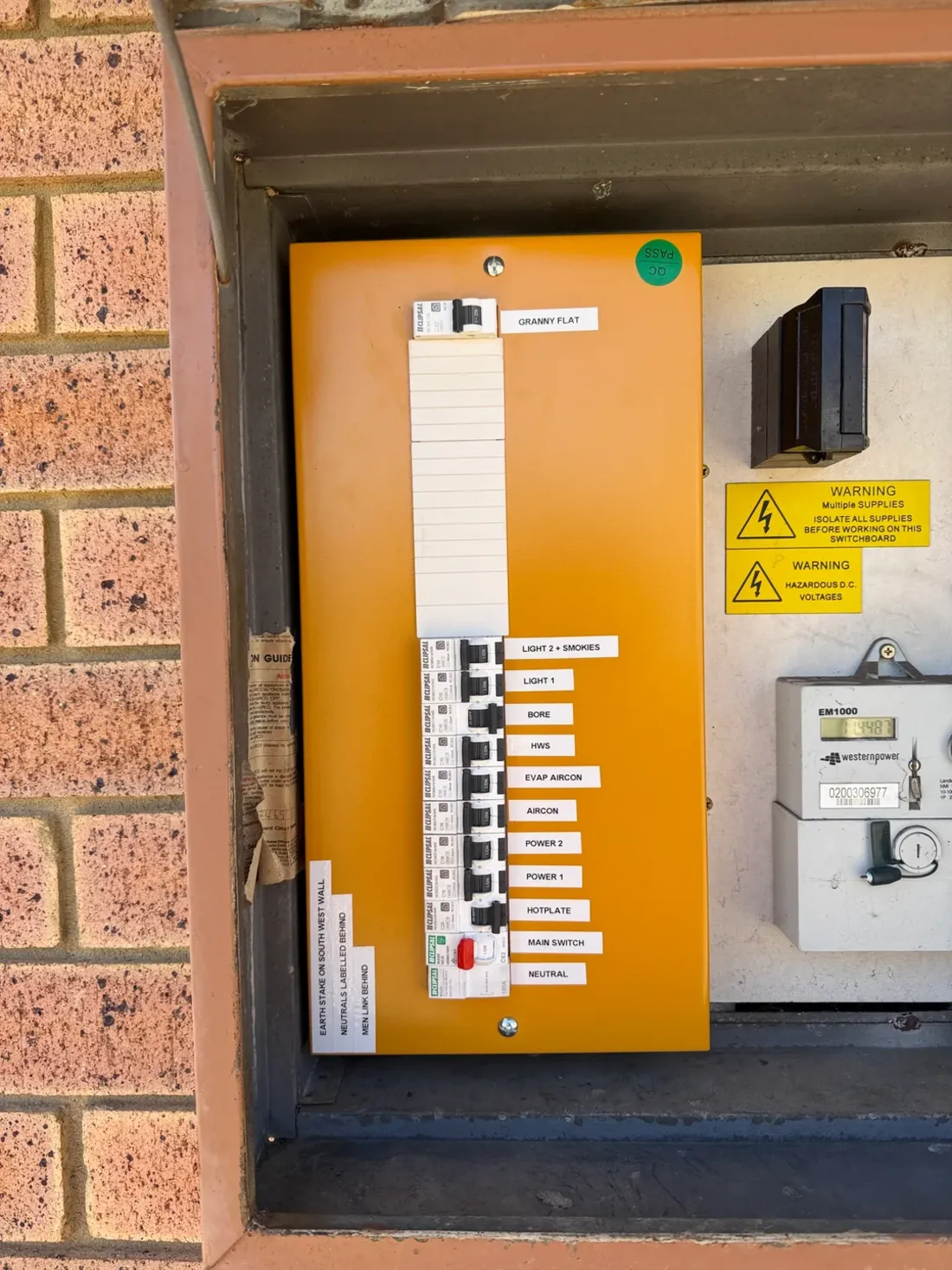
A new board, an RCBO per circuit rather than shared protection, every circuit tested and properly labelled, the mains and the incoming supply checked to make sure they carry what you are asking for, and provision deliberately left for whatever you have told us is coming.
Power is off for part of the day, planned around you. You get compliance testing, the certificate you are entitled to, and the old board taken away. We check the smoke alarms while we are there.
The recent Jarrahdale job is a fair example: a ceramic fuse board replaced with a fully labelled modern board, surge protection fitted, and space left in it for a pool heat pump and for solar and battery later on. That last part costs almost nothing at the time and saves a second visit.
FAQs
Questions on this
What is a switchboard upgrade?
Replacing the board with one built to current standards: an RCBO per circuit, correctly rated protection, proper labelling, and the mains checked to confirm they carry the load. Usually done in a day, with power off for part of it.
How old is too old for a switchboard?
Age alone is not the test. Ceramic fuses, missing or partial RCD protection, corrosion, scorching, or a board with no spare ways are the tests. Send us a photo of the board and we can tell you a great deal from it.
Can the switchboard affect my power bill?
Not directly in most cases. What it does affect is whether you can add solar, storage or a car charger, and those affect the bill considerably.
Get a quote
Send us a photo of your switchboard.
Ten seconds of your time, and it answers most of our questions: fuses or breakers, how full it is, and whether the mains are up to the job.