
Solark relocated some existing solar panels for me when I couldn't rely on anyone. Jack was very punctual, speedy and did a very good job. Quality workmanship.Emil RozkosznyPanel relocation
Solar health checks
Solar health checks across Perth, before a quiet fault costs you a year of savings.
An annual health check tells you whether yours is still earning what it should, and what it would take to put right if it is not. Panel clean included, written report with photos afterwards.
- 5 stars from 60+ reviews
- 25 year workmanship warranty on solar and battery installs
- Perth metro and surrounds
- Our own installers, never subcontracted
Free quote
Get a free quote
Signs to look for
Signs your system needs a check
Most faults do not turn a light on. These are the clues people usually notice first.
Your bill has crept up but nothing about your household has changed.
The inverter shows a fault light or an error code or the screen is blank in the middle of the day.
Nobody has been on the roof since install day and the system is more than a few years old.
Your original installer is no longer around to answer the phone, let alone check the work.
A storm or a roof repair has happened since the panels went up.
The monitoring app stopped reporting and you are not sure when it last looked right.
What is included
What a health check covers
Why systems quietly stop earning
A failed panel in a string, a dead optimiser, a faulty DC isolator, an inverter throwing errors nobody is reading, water in a rooftop isolator, or shading from a tree that was small when the system went in. None of these turn a light off in your house. They just show up as a bill that is higher than it used to be, and most people blame the retailer.
We check systems we did not install as well as ones we did. If your original installer is no longer contactable, that is a common reason people ring us.
Ask a Perth household who installed their solar. Most of them say they do not know.
What ageing actually looks like
Sun is the thing that wears a solar system out, and the parts that suffer first are the ones nobody looks at. A DC isolator sits on the roof next to the panels, in full sun every day of its life, and the enclosure goes brittle long before anything inside it fails. Once it cracks, water gets in. That is a live DC fault waiting on the next wet week.
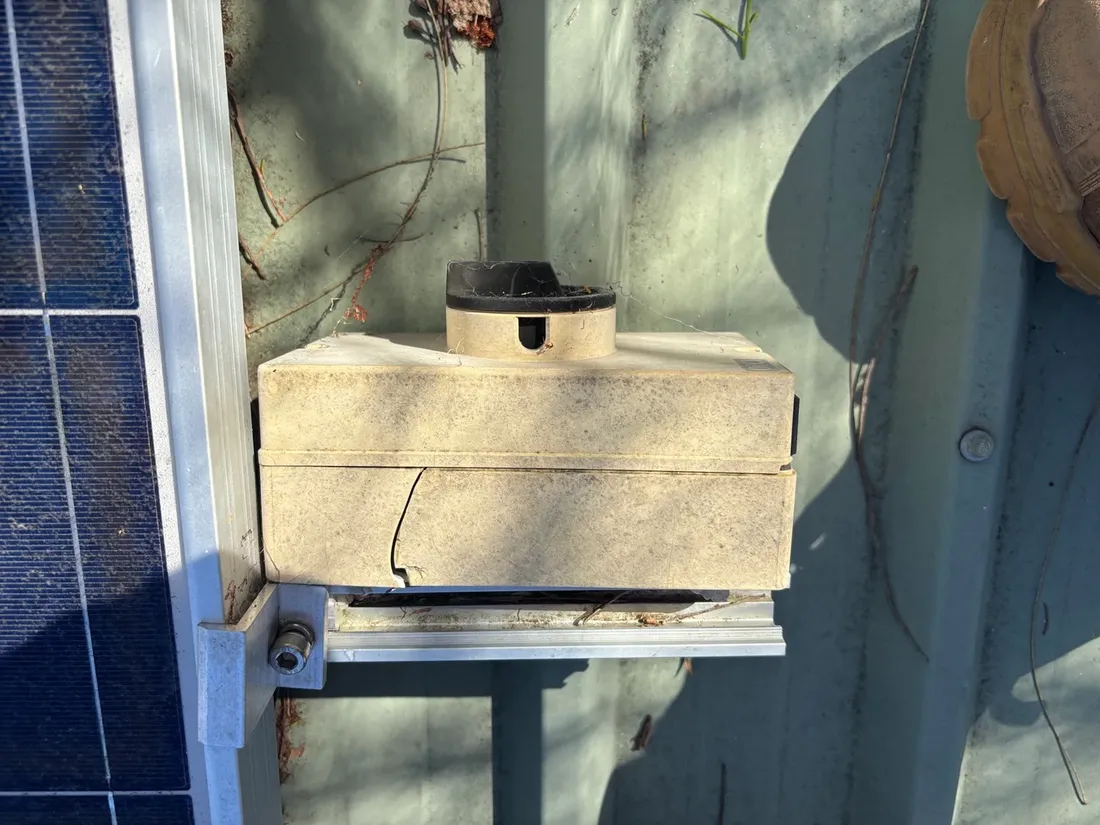
This is the sort of thing an inspection is for. From the ground, and from your monitoring, the system looks like it is working.
Panel cleaning is part of it
Perth gives solar panels a hard time. Months without rain, dust off the road, salt closer to the coast, and whatever the birds contribute. A layer you cannot see from the ground is enough to take a bite out of what the system generates, and it builds up gradually enough that nobody notices the bill creeping up.
So a clean is included in the annual health check rather than sold separately. We are already up there with the gear, and cleaning the array while we inspect it costs you nothing extra. On a recent job that meant cleaning and checking a 69 panel array in one visit. If your panels have come through the year in good shape we will say so, and the visit is still worth having for everything else on the list.
Older systems
We have checked systems 15 years old and still earning their keep. We have also found systems five years old with a failed string nobody had noticed. Age turns out to be a poor predictor of condition, which is the reason to look rather than assume.
- Inverter checked for faults, error history and actual output against expectation.
- Panels inspected on the roof for damage, delamination, hot spots and shading.
- DC and AC isolators checked for water ingress, UV damage and correct operation.
- Mounting, rails and roof penetrations checked for movement and sealing.
- Switchboard and system earthing checked, plus an RCD test and a smoke alarm check.
- A panel clean included where the array needs one.
- Monitoring set up or reconnected so you can see what the system is doing.
- A written report emailed to you after the visit, with the photos we took on the roof, in plain English rather than jargon.
How it works
How the job runs
Book it in
Ring or send a message. You do not need to know what is wrong, and most people who book one do not.
On the roof and in the board
Panels, mounting, isolators, inverter, switchboard and earthing, all checked against what the system should be producing rather than what it says it is.
Cleaned if it needs it
A panel clean is part of the annual check. If the array is already clean we will tell you and skip it rather than go through the motions.
Report, with photos
A written report emailed after the visit, in plain English, with the photos we took on the roof. What is fine, what to watch, what needs fixing and what it will cost.
Aftercare
The same number to ring if anything is not right afterwards. Your guarantees under the Australian Consumer Law apply to our work, as our Warranty Terms set out.
FAQs
Questions we get asked
How do I know if my system needs a check?
The usual signs are a power bill that has crept up without your usage changing, an inverter showing a light or a code you do not recognise, or simply not having looked at the monitoring in over a year. If your system was installed by someone you can no longer contact, that is reason enough on its own.
Beyond the warning signs, we recommend a health check annually. That is the interval Australian Standards work to for an installation of this kind, and it is the interval that catches a failed string in the year it happens rather than three years later.
Do you check systems you did not install?
Yes, and a good share of the checks we do are exactly that.
How often should a system be checked?
Annually, in line with Australian Standards for an installation like this. Between visits, a look at your monitoring every few months catches most problems early and costs you nothing.
What if you find something wrong?
You get told what it is, what it is costing you and what the fix involves, in plain terms. If it is under a manufacturer warranty we will tell you that too, even where it means we do not get paid for the repair.
Get a quote
Not sure your solar is still earning?
Book a health check and find out, rather than guessing from your bill.
5 stars from 60+ reviews
Jack managed to arrive on site the very next morning and managed to get my bore pump up and running. Always good service from solark.Frederick GumbletonBore pump fault
Free quote
Tell us about the job
Working across Perth metro and surrounds, including Baldivis, Byford, Canning Vale, Joondalup, Ellenbrook, Rockingham, Midland, Fremantle. See every suburb we cover.