
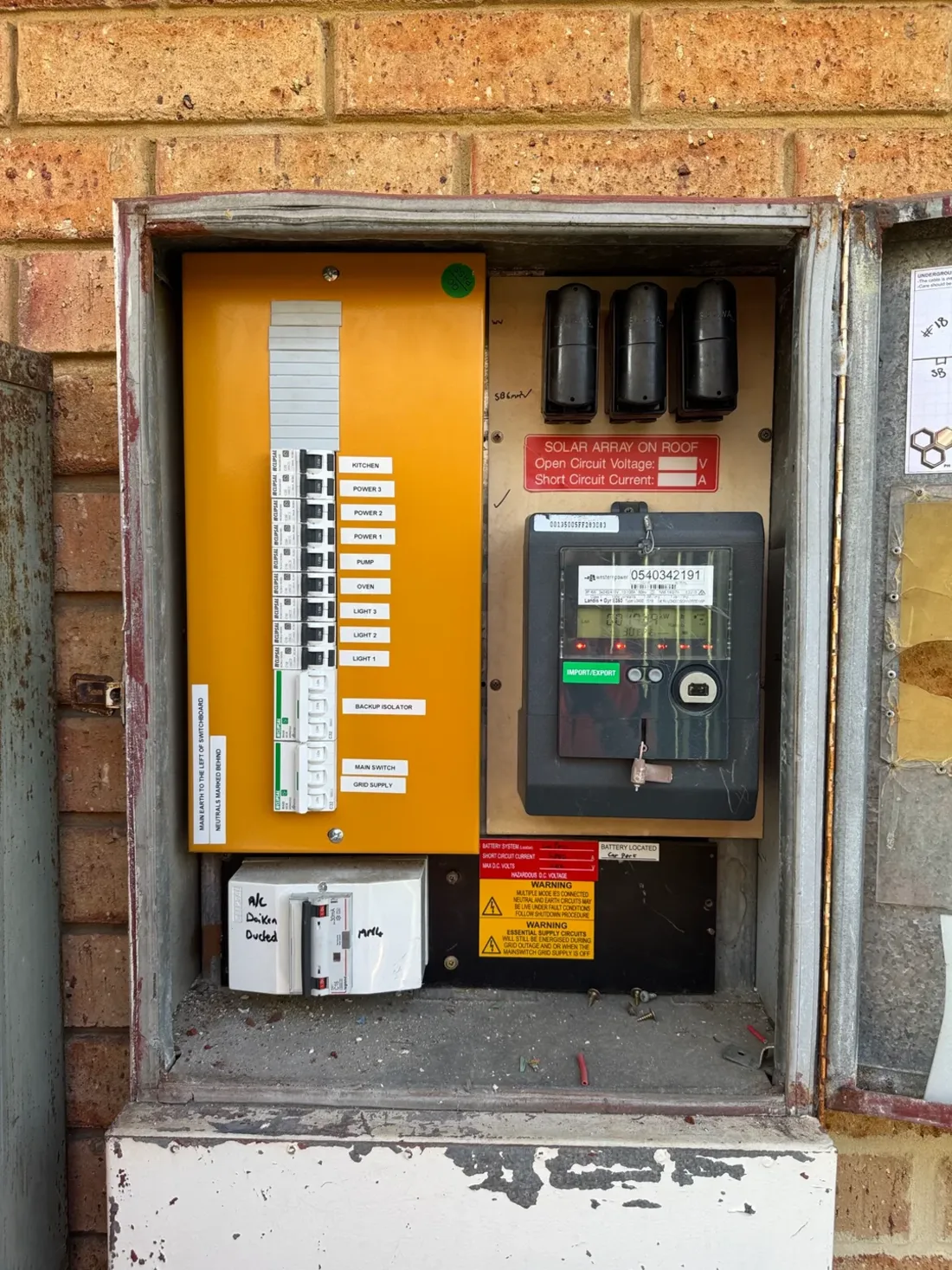
Electrical faults
Ceramic fuses and old switchboards: are they still safe?
A ceramic fuse board can keep working for decades. What it cannot do is protect a person from a shock.
Ceramic fuses, also called rewireable fuses, are the white porcelain plugs in older Perth switchboards. Each one holds a length of fuse wire that melts if too much current flows, which protects the cable from overheating. What they do not do is protect people. A shock through a person draws far too little current to blow a fuse, so a fuse board on its own does nothing to stop it.
That is why an old fuse board is worth replacing even when it appears to work perfectly. The protection that matters for people is the safety switch, or RCD, and most fuse boards have none, or one covering only part of the house.
Is it dangerous?
A fuse board that is not showing any symptoms is not an emergency, but it is a gap in protection. Treat it as urgent if:
- There is a burning smell, scorching, melted plastic or heat around the board. Switch off at the main switch if safe, and call 000 if there is smoke or fire.
- A fuse carrier is cracked, loose, or shows signs of arcing.
- Somebody has fitted heavier wire, a nail or anything else in place of fuse wire. That removes the protection entirely.
- Anyone has had a tingle or shock anywhere in the house.
What you can safely check
Look, do not touch. Open the meter box door and note:
- Fuses or breakers. Ceramic fuses are rectangular porcelain plugs. Circuit breakers are switches with a lever.
- Safety switches. An RCD has a test button, usually marked T. Count them, and note whether anything is labelled as being protected by them.
- The panel. Older meter panels are a dark, flat board. Older ones can contain asbestos, so do not drill, cut or scrape it.
- Labels and space. Handwritten, faded or missing labels, and no spare space, both point to a board that has been added to over the years.
- Marks. Browning, scorching or melted plastic anywhere on the board.
Take a photo. Do not remove covers, pull fuses or touch anything behind the door. If a fuse has blown, do not rewire it. Unplug what was running on that circuit and call an electrician.
What usually causes the problems
No protection for people
The biggest issue is not a fault at all. Fuse boards were built before RCDs were standard, so a fault that sends current through a person, or into a metal fitting, is not cut off. Many boards had one RCD added later for a few circuits and nothing on the rest.
Wrong fuse wire
Over decades, blown fuses have been rewired by whoever was home with whatever wire was handy. Wire heavier than the rating lets the cable carry more than it should, and the fuse no longer protects anything.
Heat and age
Fuse carriers and their contacts loosen and corrode. A poor contact runs hot, and heat is where switchboard fires start.
Load it was never built for
These boards were wired for a house with a fraction of today's appliances. Air conditioning, induction cooking, solar, batteries and car charging all need capacity and space a fuse board does not have.
What an electrician does
- Inspects the board, the meter panel, the main switch and the incoming mains, and checks the panel for asbestos risk.
- Identifies every circuit and tests the wiring behind it, because old circuits sometimes have faults that only show once RCD protection is added.
- Gives you a fixed price for a new board, with what is and is not included spelled out.
- On the day, fits the new board with safety switch protection on every circuit, ideally an RCBO per circuit, and labels each one.
- Tests everything, provides the compliance paperwork, and leaves room for solar, a battery or a car charger if you are planning one.
What drives the price of that job is covered in switchboard upgrade cost in Perth.
When to call
Straight away if there is any heat, smell, scorching or a shock. Otherwise, call when you still have fuses and no RCD on some circuits, when you are selling or renting, when a fuse keeps blowing, or before you add solar, a battery, an EV charger or an air conditioner. Homes being sold or rented in WA must have at least two RCDs protecting all power and lighting circuits, which we explain in WA smoke alarm and RCD rules for sale and rental homes.
Send a photo of the board through our switchboard upgrades page or contact us, open 8:30am to 5pm, seven days. If an old board starts tripping, safety switch keeps tripping explains what to check first.
FAQs
Questions on this
Can I replace the fuse wire myself?
No. Rewiring a fuse is work on the switchboard, and it is easy to fit the wrong wire. Fuse wire that is too heavy lets a cable overheat. If a fuse has blown, leave it out, unplug what was running on that circuit, and call an electrician.
Are ceramic fuses illegal in WA?
An existing board is generally not required to be upgraded just because it is old. But homes being sold or rented must have at least two RCDs protecting all power and lighting circuits, and many fuse boards do not.
How do I know if my board has asbestos?
You cannot tell by looking. Older meter panels can contain asbestos, so treat any old dark panel as if it does. Do not drill, cut, sand or scrape it. We assess it when we look at the board.
What does an upgrade replace?
The fuses with circuit breakers and safety switches, ideally an RCBO per circuit, with every circuit tested and labelled. Whether the meter panel, main switch or mains also need replacing depends on what we find.
Get a quote
Still running on ceramic fuses?
Send us a photo of the switchboard with the door open. It tells us most of what we need to know about what an upgrade involves.