
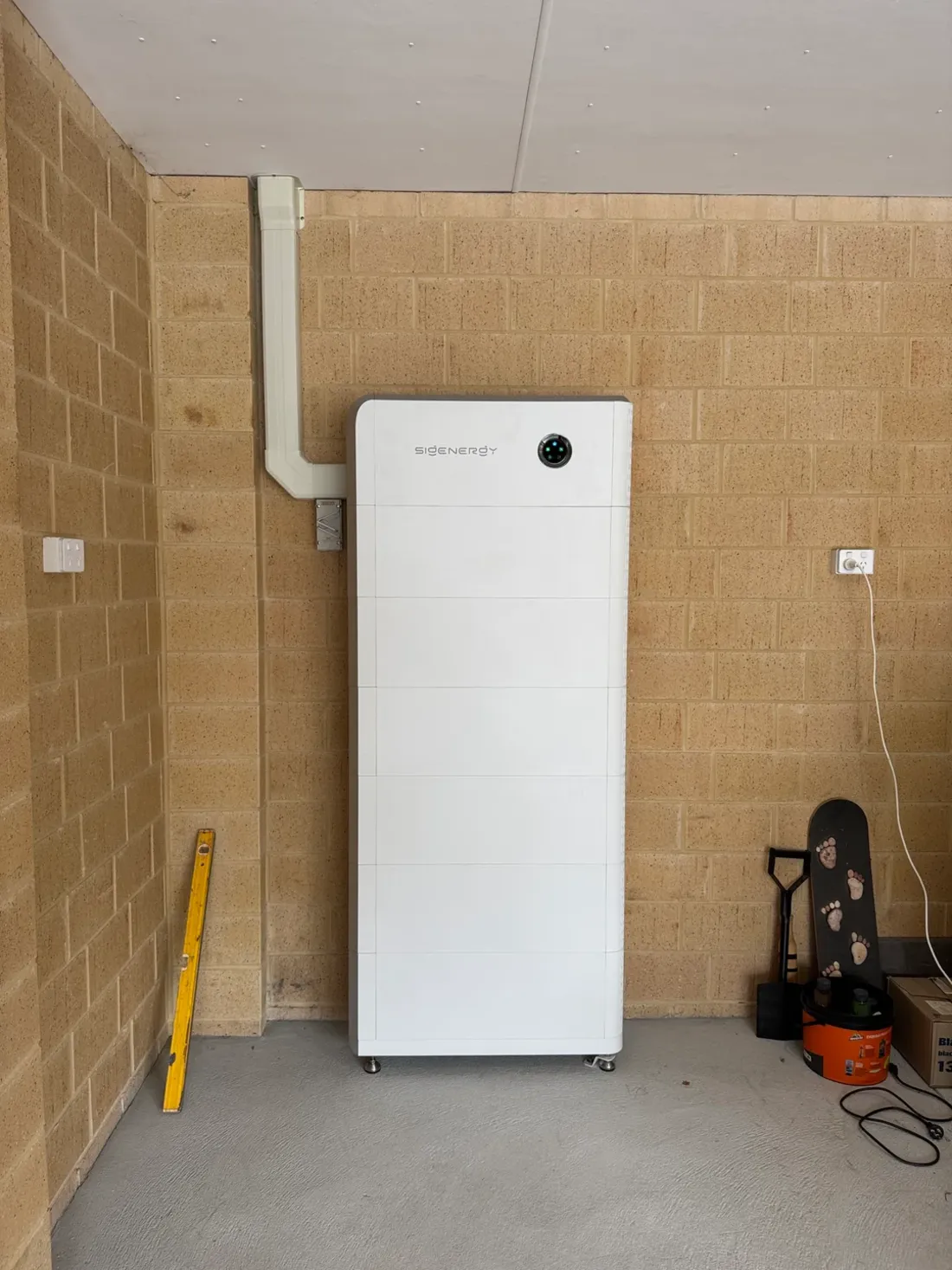
Batteries
What size solar battery do I need for a Perth home?
A battery should be about the smaller of your overnight use and your daily solar surplus. Here is how to work out both from your bill, and what moves the answer.
The right battery size for a Perth home is roughly the smaller of two numbers: how much power you use between sunset and sunrise, and how much spare solar you export on a typical day. A battery bigger than your overnight use sits partly full. A battery bigger than your surplus never fills. Then you adjust for blackout backup, for winter, and for the points where the WA and federal rebates change.
You can do a first pass yourself with a power bill in ten minutes. Here is the method, then the things that move the answer.
A simple sizing method using your bill
- Find your daily grid import. On a solar home, the units you buy are mostly the power you use when the panels are not covering you, which is largely evenings and overnight. Divide the units bought by the number of days in the billing period.
- Find your daily export. Divide the units exported by the number of days. That is the surplus a battery could have stored.
- Take the smaller number. That is roughly the usable capacity you could fill and empty on a typical day.
- Allow for losses. A battery gives back a little less than it takes in, so you need slightly more surplus than the capacity you plan to use.
- Repeat with a summer and a winter bill. Perth panels average about 4.4 kWh per kW per day across the year, but winter days produce much less. A battery sized off a summer bill may not fill in July.
An example, not a real household: a 90 day bill shows 900 units bought and 1,350 units exported. That is 10 kWh a day bought and 15 kWh a day exported. The smaller figure is 10, so around 10 kWh of usable capacity is the starting point. If the winter bill shows export falling to 6 kWh a day, the battery will only part-fill for some of the year, which is worth knowing before buying something larger.
Better: use your interval data
A bill averages everything. If you have an advanced meter, your retailer can give you interval data showing your use and export through the day. That shows exactly how much you draw from late afternoon to the next morning, and how much of it falls between 3pm and 9pm. That window matters on Synergy's Midday Saver plan, where it costs 55.33c a unit.
Interval data also shows the spikes. A battery has a power limit as well as a capacity. If your evening runs the oven, the air conditioning and the dryer together, the battery's output in kW matters as much as its size in kWh.
Usable capacity versus the number on the box
Batteries are often sold on a headline figure, but what you can actually draw out is the usable capacity, which can be lower. The rebates are worked out on usable capacity too. When comparing quotes, line up usable capacity, and ask whether the system holds a reserve back for blackouts, because a reserve you never touch is capacity you are not cycling. Our guide to choosing a battery covers the rest of the spec sheet.
Backup changes the answer
If you want the house to keep running through outages, you may want more capacity than your evening use suggests, or a reserve kept back every night. Decide what needs to stay on before choosing the size. The fridge, lights and internet need far less than ducted air conditioning. More in home battery backup.
The rebate points that shape sizing
Two thresholds are worth knowing, because they change what each extra kWh costs after rebates:
- 10 kWh, the WA cap. The WA Residential Battery Scheme pays on usable capacity up to 10 kWh, up to $1,300 for Synergy customers. Above that, the WA rebate stops growing.
- 14 kWh, the end of the federal full rate. The Cheaper Home Batteries discount pays the full rate on the first 14 kWh, 60% from 14 to 28 kWh and 15% from 28 to 50 kWh.
So the kWh between 10 and 14 earn the federal discount only, and above 14 kWh each one earns less again. Neither is a reason to buy a size you will not use, but both are a reason to check that the next size up is justified by your data. The WA battery rebate guide has worked examples.
What each common size suits
- 10 kWh: small to medium evening use, and the full WA rebate
- 13.5 kWh: heavier evening use, still entirely inside the federal full-rate band
- 20 kWh: large homes running air conditioning into the evening, or longer backup
- 30 kWh: very high use, several EVs or long outages, with a large solar system to fill it
Every size needs enough solar to fill it. If your export is small, the answer may be more panels first, or both together. See what size solar system you need.
Plan for the next few years
An EV, a switch to electric cooking or heat pump hot water, or kids becoming teenagers can all change your evening use. Size for what you realistically expect over the next few years, not just last quarter. Some batteries can take extra modules later, which is a reasonable way to start smaller.
When you are ready, send a year of bills or your interval data through our battery storage page and we will run the numbers. If the answer is a smaller battery, or no battery yet, we will say so.
FAQs
Questions on this
Is there a simple solar battery size calculator?
Your bill is the calculator. Divide the units you bought by the days in the billing period, then do the same for the units you exported. The smaller of the two is roughly the usable capacity you could fill and use on a typical day. Repeat it with a winter bill before you decide.
What size battery do I need for a 6.6 kW solar system?
It depends on how much of its output you export. A 6.6 kW system averages roughly 29 kWh a day across a Perth year, less in winter, and some of that you use as it is made. Size the battery to what is left over and to your evening use, not to the panel size.
Is a 10 kWh battery enough?
For a household that uses around 10 kWh or less between sunset and sunrise, often yes, and 10 kWh is the size that earns the full WA rebate. If your interval data shows heavier evening use, or you want long backup, look at 13.5 kWh or more.
Should I get a bigger battery to get a bigger rebate?
No. The WA rebate stops growing at 10 kWh, and the federal discount drops to 60% above 14 kWh and 15% above 28 kWh. Above those points each extra kWh earns less, so buy the size your data supports.
Get a quote
Want your battery sized from your own data?
Send a year of bills or your interval data. We will tell you the size that fits, and if the answer is smaller, or not yet, you will hear that too.