
EV charging
EV charging at home in Perth: single phase or three phase?
Most Perth homes charge an EV fine on single phase. What matters more is how you charge, what your switchboard can take, and when you plug in.
Most Perth homes can charge an electric vehicle perfectly well on single-phase power. A dedicated wall charger on a single-phase supply typically runs at around 7 kW, which covers ordinary daily driving with a few hours plugged in. Three-phase power allows faster AC charging, up to around 22 kW, but only helps if your car can accept it and your supply and switchboard can carry it.
For most people the bigger decisions are how you charge (a cable from a normal power point, a 32 amp socket or a wall charger) and when. On Synergy's Midday Saver plan, grid power between 9am and 3pm costs 8.8520c a kWh, and solar you would otherwise export earns only 2c under DEBS. Charging in the middle of the day is where home EV charging gets cheap.
Three ways to charge at home
A portable cable from a normal power point
Many EVs come with a portable charging cable, often called a granny cable, that plugs into an ordinary power point. It is the slowest option. If you drive short distances and the car sits plugged in overnight, it can be all you need.
It is also a heavy load on a power point for hours at a time. Plug it straight into a wall outlet in good condition, never through an extension lead or a double adaptor. If the plug or the power point gets warm, discoloured or smells hot, stop using it and get the circuit checked. Our post on a burning smell from a power point explains why that matters.
A 32 amp socket
A 32 amp socket is a heavy-duty outlet on its own dedicated circuit, built for a portable charger with a matching 32 amp plug. On single phase it lets that charger run at roughly the same rate as a typical wall charger. It suits people who already own a capable portable unit or want to take it with them. It still has to be installed by a licensed electrician on a dedicated circuit with the right protection, and an outdoor socket needs the right weather rating.
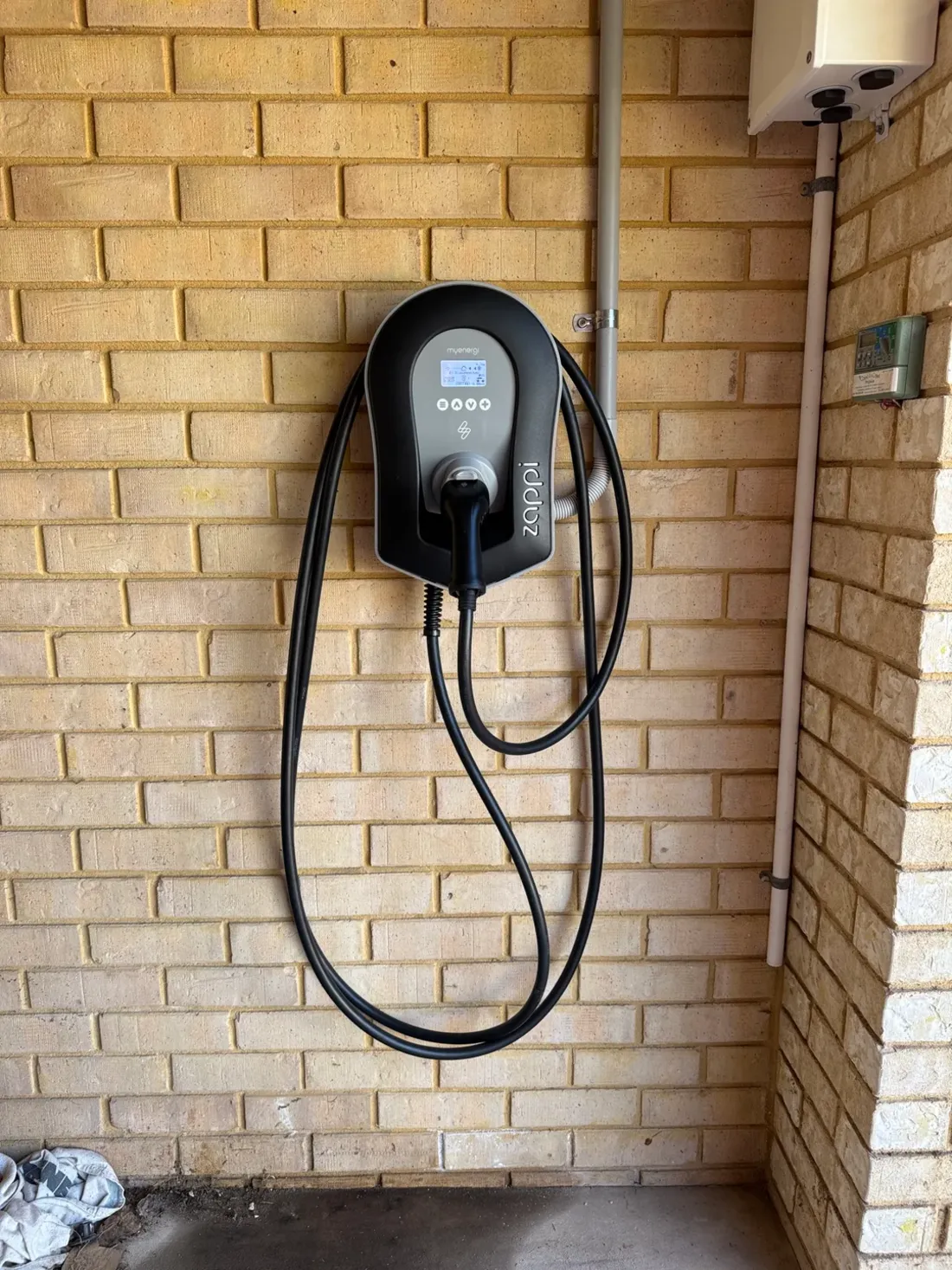
A dedicated wall charger
A wall charger is fixed in place on its own circuit. Most can schedule charging, many can manage load so the house supply is not overloaded, and some follow your solar so the car takes surplus generation. For most households keeping the car for years, it is the tidiest long-term answer. Our EV charger installation page covers what we check and fit.
Single phase vs three phase, plainly
Power reaches a house on one active conductor (single phase) or three (three phase). Many Perth homes, particularly older ones, are single phase. Three phase is more common on larger homes and properties with big loads such as ducted air conditioning, a pool or a workshop.
You can often tell which you have from the switchboard. Open the board's door, without removing any covers, and look at the main switch. A single-phase main switch is usually one switch. A three-phase main switch is usually three switches joined together so they move as one. If you are not sure, a photo of the board is enough for us to tell you.
What each can charge at, in general terms:
- Single phase: wall chargers commonly run at around 7 kW.
- Three phase: wall chargers can run at up to around 22 kW.
The catch is the car. Every EV has an onboard charger that sets the most it will take from an AC charger, and plenty of cars accept less than a three-phase charger can deliver, or charge on single phase only. Check your car's maximum AC charging rate before paying for three-phase anything.
To see whether single phase is enough, use your car's app, which shows its energy use per 100 km. Turn a typical day's driving into kWh and divide by 7. That is roughly how many hours of single-phase wall charging a day of driving needs. For most households it is a few hours, comfortably inside a night or a sunny afternoon.
Switchboard and supply checks
A wall charger or 32 amp socket is a large load that runs for hours. Before quoting, a licensed electrician should check:
- The incoming supply and main switch rating, and what the house already draws at its busiest
- Whether the switchboard has room for a new circuit with the right protection
- The cable run from the board to where the car parks, because a long run changes the cable size
- Whether load management is needed so the charger backs off when the oven and air conditioner are running
Older boards with ceramic fuses or no room left often need work first. See ceramic fuses in an old switchboard and our switchboard upgrades page.
Charging from solar and cheaper tariffs
On Midday Saver, from 1 July 2026, Synergy charges 8.8520c a kWh from 9am to 3pm, 55.3253c from 3pm to 9pm and 24.3431c from 9pm to 9am, with a supply charge of 132.7806c a day. It needs an advanced (AMI) meter. Charging at the wrong time on this plan is expensive: plugging in when you get home at 6pm puts the car on the peak rate. Set the charger's schedule. Our guide to Synergy's Midday Saver covers who the plan suits.
If the car is away during the day, Synergy's EV Add On adds a cheaper overnight band to Midday Saver. Check the current hours and rate on synergy.net.au or in our EV Add On explainer.
With solar, every kWh into the car is a kWh you are not exporting at 2c. A solar-aware charger matches the charging rate to your surplus. On a smaller system the surplus may be less than the charger can take, and the gap comes from the grid at the midday rate. If you are planning panels with an EV in mind, see what size solar system you need.
When a three-phase upgrade is worth asking about
If you already have three phase and your car can use it, use it. If you are on single phase, an upgrade is worth asking about when:
- Your car accepts three-phase AC charging and you genuinely need it faster, for example two EVs or long daily distances with little time at home
- The supply is already stretched by ducted air conditioning, a pool or a workshop, and the charger would add to it
- The switchboard is being replaced anyway
It is usually not worth it if your car only charges on single phase, or it sits plugged in for most of the night.
Changing the supply is arranged with Western Power, and your electrician handles the work on your side of the meter. The cost and the wait vary a lot from site to site, so we will tell you what yours involves after a look rather than guess. Solar on its own is no longer a reason to go three phase: since 1 May 2026 Western Power allows up to 30 kVA of inverters on single or three phase, as our post on Western Power's export limits explains.
FAQs
Questions on this
Can I charge an EV on single-phase power?
Yes. A single-phase wall charger typically runs at around 7 kW, which covers ordinary daily driving with a few hours plugged in. Most Perth homes charge on single phase without any trouble once the switchboard and circuit are right.
Is a 32 amp socket good for EV charging?
It can be, if you have a portable charger built for a 32 amp plug. On single phase it charges at roughly the same rate as a typical wall charger. It needs its own dedicated circuit installed by a licensed electrician, and it lacks the scheduling and solar features many wall chargers have unless your portable unit provides them.
Do I need three-phase power for an EV charger?
Usually not. Three phase only charges faster if your car accepts three-phase AC charging, and many cars take less than a three-phase charger can give. Check your car's maximum AC rate first.
What is the cheapest time to charge an EV in Perth?
On Synergy's Midday Saver, 9am to 3pm at 8.8520c a kWh, or from your own solar during the day. Avoid 3pm to 9pm on that plan, when the rate is 55.3253c. If the car is out all day, the EV Add On gives Midday Saver a cheaper overnight band.
Can I plug my EV into a normal power point?
Yes, with the cable that came with the car, straight into a wall outlet in good condition and never through an extension lead or double adaptor. If the plug or outlet gets warm or smells hot, stop and have it checked by an electrician.
Get a quote
Ready to charge at home?
Send a photo of your switchboard and tell us where the car parks. We will tell you what your supply can take and what the install involves.