
Electrical faults
Half the house has no power: what to check
Part of the house dead and part working is usually the switchboard. Sometimes it is the network, and then it is Western Power's job.
When half the house has no power and the rest is working, the most common cause is a tripped safety switch or circuit breaker, because each one covers a group of circuits. Check the switchboard first. If everything there is on, and you have three-phase power, you may have lost a phase on the incoming supply, which is a network fault for Western Power on 13 13 51.
If one room is out, it is almost always one circuit: tripped protection, or a loose connection on that circuit. If the neighbours are also partly out, it is the network.
Is it dangerous?
Partial power is usually not dangerous in itself. These signs change that:
- Lights going brighter than normal, or some bright and some dim, or appliances behaving strangely. That can be a neutral fault. Switch off at the main switch if safe and call Western Power on 13 13 51.
- A tingle from a tap, shower or any metal fitting. Do not touch it again, switch off at the main if safe, and call Western Power on 13 13 51.
- A burning smell, heat or scorch marks at the switchboard or meter box. Switch off at the main if safe, and call 000 if there is smoke or fire.
- Fallen or damaged power lines. Stay well away and call Western Power on 13 13 51.
What you can safely check
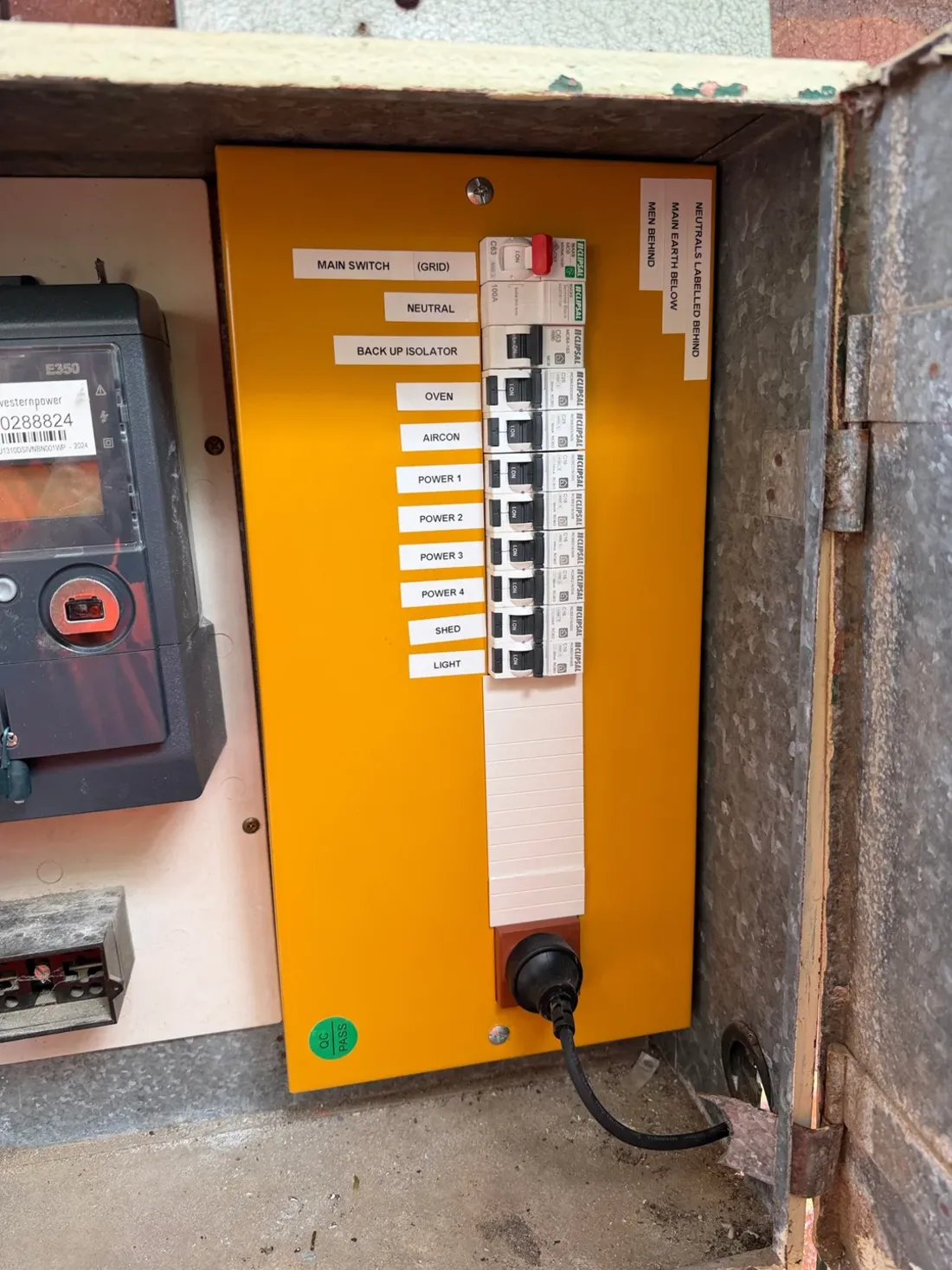
- The switchboard. Open the meter box door and look for a safety switch or breaker in the off position. Unplug what was running on the dead part of the house, then reset it once. If it trips again, see safety switch keeps tripping or circuit breaker keeps tripping.
- Single-phase or three-phase. A three-phase home usually has a wider main switch made of three switches joined together. If you are not sure, the meter or your bill may say.
- The neighbours. Ask whether they have lost some or all of their power.
- The Western Power outage map. Check whether there is a known outage or fault in your street.
- A battery system. If you have a battery with backup and the grid is down, only the backed up circuits will run. Check the battery app or display.
Do not open the switchboard or the meter, and do not touch anything behind the meter box door except the switch levers.
What usually causes it
A tripped safety switch
Older boards often have one or two safety switches, each covering a big group of circuits. When one trips, a large part of the house goes dark at once, which is where the name of this problem comes from. A faulty appliance or moisture is the usual trigger.
A tripped circuit breaker
A single circuit, often one room or one side of the house. Overload is the most common reason.
A lost phase
Three-phase homes have their circuits split across three lines. If one fails on the network or in the service cable, the circuits on that line go dead with nothing tripped in the house. Three-phase appliances, such as some air conditioners, may stop altogether. This is Western Power's to fix.
A loose or failed connection
A loose terminal in the switchboard, a joint in the roof, or a failed connection at an outlet can kill a circuit, or everything downstream of it, with nothing tripped. These connections heat as they fail.
Battery backup by design
Many home batteries only back up chosen circuits. In a blackout the lights and fridge might run while the oven and air conditioner do not. That is the design, not a fault. Home battery blackout backup explains how it works.
What an electrician does
- Checks the incoming supply on each phase at the meter box, to confirm whether the problem is the network or the house.
- If it is the network, tells you what was found so you can report it to Western Power.
- If it is the house, checks the protection devices and works out which circuits are dead.
- Traces the break with testing equipment and checks each termination for heat damage.
- Repairs it at a fixed price agreed once the fault is found.
When to call
Call Western Power on 13 13 51 first if neighbours are affected, if you have three-phase power and nothing has tripped, if lights are going bright and dim, if there is a tingle from a tap, or if lines are down. Call us if the network is fine and part of the house is still dead, or if a safety switch or breaker will not reset. Our fault finding service is charged hourly, with the rate told up front. Get in touch between 8:30am and 5pm, seven days.
If it is a single outlet rather than a room, see power point not working.
FAQs
Questions on this
Why has one room lost power?
Usually a tripped safety switch or circuit breaker covering that room. If nothing has tripped, a loose connection on that circuit is the next most likely cause.
What does losing a phase mean?
A home with three-phase supply gets power on three separate lines. If one of those fails, the circuits on that line go dead while the rest keep working. It is usually a network or service fault, so call Western Power on 13 13 51.
Why do only some circuits work in a blackout when I have a battery?
Many battery systems back up selected circuits rather than the whole house. In a blackout, only those keep running, which is normal behaviour rather than a fault.
Should I call Western Power or an electrician?
Western Power for anything on the network side: neighbours affected, a lost phase, lines down, or lights going bright and dim. An electrician for anything inside your home, such as a protection device that will not reset.
Get a quote
Part of the house still dark?
If nothing has tripped and Western Power say it is not theirs, tell us which rooms are out and when it started.